
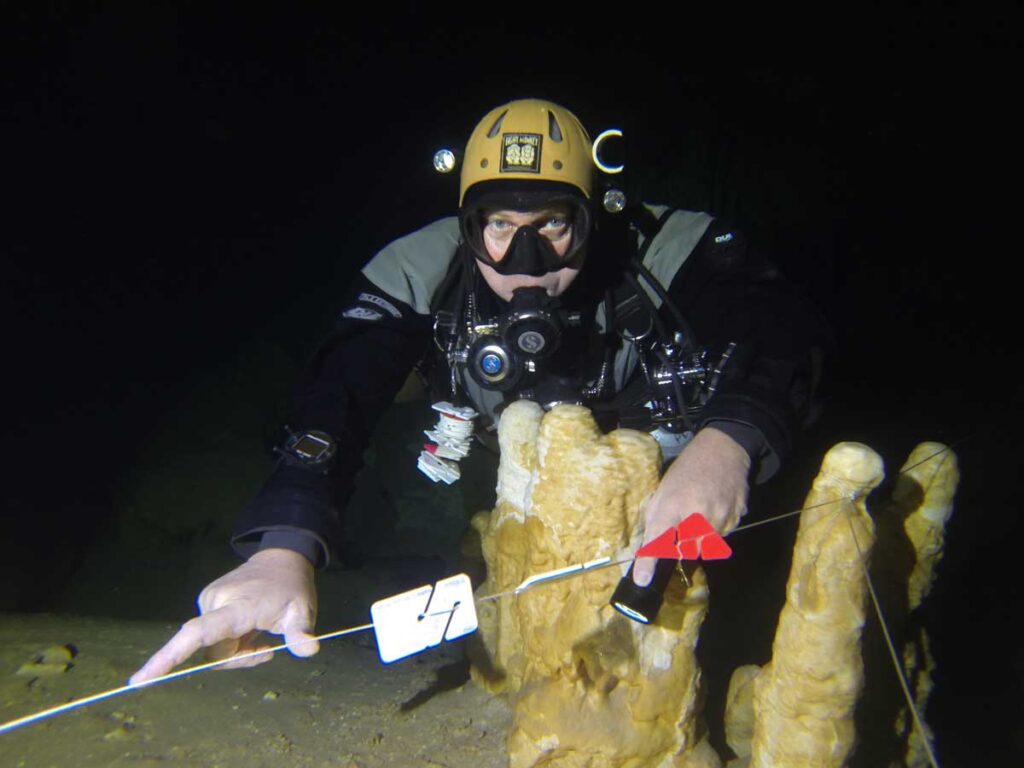
COMPLEX NAVIGATION IN CAVE DIVING: BEYOND THE LINE
Cave Diving is often described as one of the most demanding forms of underwater exploration, and NAVIGATION is at the core of that challenge.
While recreational divers rely on open water references and simple routes, Cave Divers operate in an environment where a wrong turn can be fatal.
Complex navigation goes far beyond ¨following the line¨– it require planning, awareness, discipline, and constant mental mapping.
WHAT MAKES CAVE NAVIGATION ¨COMPLEX¨?
In its simple form, cave navigation involves a single main guidline leading directly to an exit. COMPLEX ,navigation begins when a diver encounters:
. Multiple permanent lines
. Intesections, jumps and gaps
. Circuits and traverses
. Restrictions and changes in cave morphology
. Areas with poor visibility or haloclines
At this point navigation become a three dimensional problem solved under stress, limited visibility, and time pressure.
THE GUIDELINE: FOUNDATION, NOT A CRUTCH
The guideline is the primary safety tool in cave diving, but complex navigation demands active interpretation, not passive following.
Divers must constantly know:
. Which line they are on
. Where that line leads
. What other line intersect it
. How far they are from the exit
. Direction toward the exit ( uw compass is a must)
In complex systems, blindly following a line without awareness can lead a diver deeper into the cave rather than out.
JUMPS, GAPS, INTERSECTIONS and MARKERS
Complex navigation often involves leaving the main line to explore side passages:
. JUMPS and GAPS are distances between lines
. INTERSECTIONS are like crossroads
THESE REQUIRE:
. Accurate placement of jumps/gaps reels
. Clear marking conventions
. Verification by the entire team
Directional markers ( ARROWS), and personal markers ( Cookies and REM), are critical, but they works only if divers understand who placed them, why, and in which direction they point.
MENTAL MAPPING AND SPATIAL AWARENESS
Experienced cave divers develop a mental map of the cave as they move. This includes:
. Compass headings
. Depth changes
. Time and distance estimates
. distinctives features ( formations, restrictions, sediment…)
The mental map allows divers to detect errors early.
If the cave ¨doesn´t feel right¨ probably isn´t
THE IMPORTANT ROLE OF THE COMPASS
In complex navigation, the compass is more than a backup tool:
. Helps detect loops and circuits
. Assist during lost line scenarios
. Support navigation in good, low or no visibility
A dive who knows the general heading of the exit has a critical advantage in an emergency.
TEAM COMMUNICATION AND DISCIPLINE
Complex navigation is a team and a personal skill.
Every diver must:
. Understand the dive plan
. Agree on navigation decisions
. Verify line placements and markers
. challenge anything that seems wrong
STRESS, TASK LOADING, AND HUMAN ERROR
Navigation errors often happen when divers are:
. Over tasked
. Fatigued
. Rushing due to gas or time limits
. Distracted by equipment or environmental conditions
. Distracted by filming or photographing
Complex navigation requires slowing down, even when stress try to push you speeding up, precision always beat haste in caves.
TRAINING AND PROGRESSIVE COMPLEXITY
Safe cave divers build navigation skills gradually:
1 Simple penetrations
2 Limited jumps/gaps or intersection
3 Circuits with clear references
4 advanced traverses
Skipping steps or diving beyond training dramatically increases risk.
FINAL CONCEPT
Complex navigation in cave diving is not about bravado or exploration alone – it is about control, awareness and humility.
The cave does not forgive mistakes, but it does reward discipline and preparation.
In cave diving, knowing where you are, how you got there, and how to get out is not an optional. It is the difference between a successful dive and a fatal one.
Alberto Salvini
IANTD Mexico IT #804