
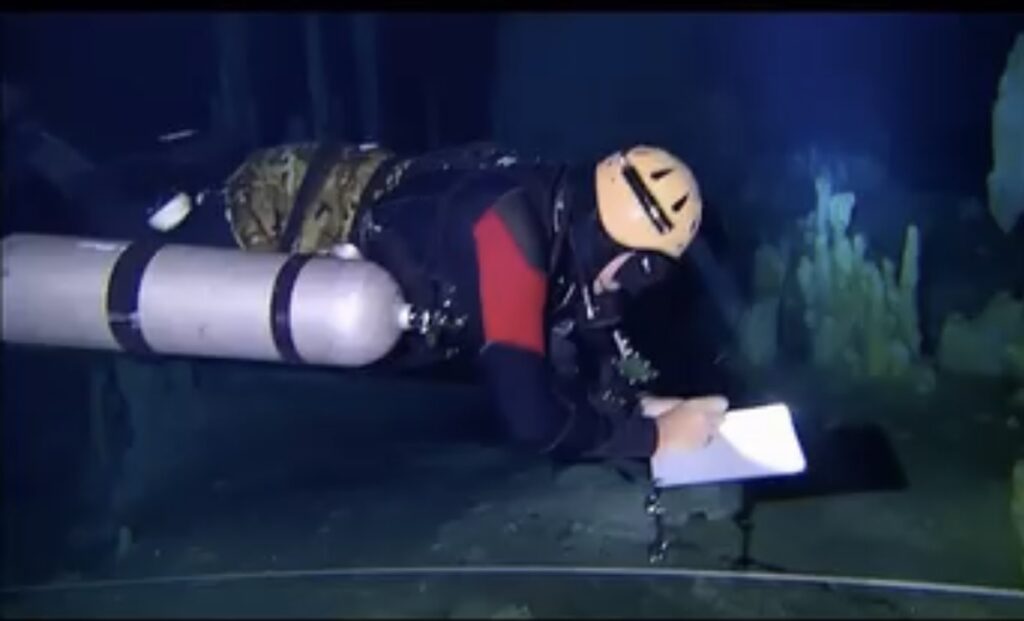
USE OF UNDERWATER COMPASS IN CAVE DIVING
The use of a compass in cave diving is critical, because caves remove or severely limit natural orientation.
Caves have almost no natural navigation:
. No sunlight
. Often poor visibility ( darkness) or no visibility( silt, tannic water, halocline)
. No clear sense of direction or distance, formations and rocks looks all the same ( especially for beginners ).
A compass provides a reliable reference for directions when your senses can´t.
Is used to be a prevention of disorientation and panic:
. Disorientation is one of the leading causes of cave diving fatalities.
A COMPASS helps you to maintain a consistent heading, helps to recognize when you are turning or looping and avoids swimming in circles without realizing it.
This is very important in silt-out situations or when viz drops to zero.
USED AS SUPPORT NAVIGATION BEYOND THE GUIDELINE
While the primary guideline is the MAIN SAFETY tool in cave diving ( remember to keep a continuous guideline to the surface!!!), a COMPASS has several and important uses:
. Confirms that you are following the correct direction
. Helps during line jumps, gaps, or complex navigation
. Is essential if you temporarily loose the line.
REMEMBER COMPASS+LINE=REDUNDANCY
COMPASS USE HELPS WITH CAVE MAPPING AND PLANNING
Compasses are used to:
. Record headings for cave maps
. Plan penetrations and exits
. Communicate navigation plans within a dive team
Accurate heading reduce errors and improve team coordination.
IS AN AID IN EMERGENCY EXITS
In emergencies like lost line, light failure, silt out:
. A known compass heading can guide you toward the exit or known passage
. It reducing decision-making under stress ( left or right are not an option).
Even rough directional references can save critical time and gas.
IS ESSENTIAL FOR TEAM AWARENESS
When all divers track headings:
. The tam shares a mental map of the cave
. Mistakes are more likely to be seen early.
RESUME IN SHORT
A compass in cave diving is important because it:
. Maintains orientation
. Reduce disorientation and panic
. Provide redundancy to the guideline
. supports safe navigation and emergency response.
CAVE DIVING RULE OF THUMB:
¨If you don´t know where you are or which way out is, you are already in trouble.¨
Alberto Salvini
IANTD MEXICO IT #804